The Turnstile Before the Ticket Scan
The turnstile before the ticket scan shows how stadium entry combines ticket checks, barriers and human help, and why the right route varies by ground.
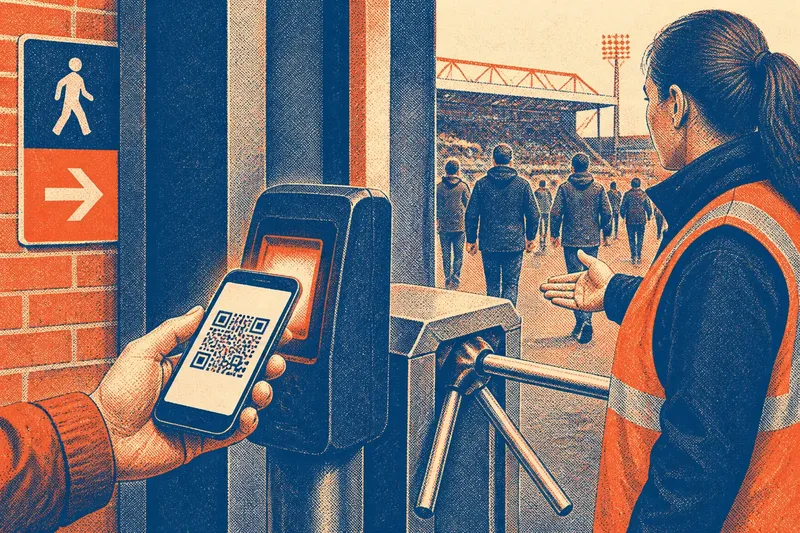
Why is there still a person beside the scanner when your ticket is already on your phone? The turnstile before the ticket scan reveals how a stadium separates checking permission to enter from guiding people safely through a gate.
There is no single arrangement at every ground. Some venues pair turnstiles with digital readers; others use different barriers, staffed checks or routes for particular stands and events. The equipment tells only part of the story: staff, signs and the layout all shape the passage from street to stand.
Turnstiles and passage
A turnstile is a barrier that lets people pass through a controlled opening one at a time. At some entrances, a ticket is checked before the barrier releases or can be pushed through; at others, the arrangement differs. It is more accurate to describe what a particular gate does than to treat turnstiles as a universal counting system.
The barrier and the ticket check perform distinct jobs. A reader or attendant can check a credential, while the barrier regulates passage. Like a latch on a garden gate, one controls access through the opening; it does not, by itself, explain who is entitled to enter.
A staffed gate adds a person who can respond when the ordinary route does not fit. An attendant may direct a visitor to another lane, help with a ticket that will not display, or clarify where a particular entrance leads.
Scanners and ticket checks
A scanner reads a code from a paper ticket, card or phone and checks it through the venue’s entry system. Depending on the ticketing arrangement, that check may confirm that the credential is accepted for the entrance or area. A reader does not decide every practical question: staff and signs help people understand what to do next.
Digital entry has not removed human assistance. A dim screen, a damaged ticket or uncertainty about the correct gate can call for help. Staff may handle these exceptions while readers process tickets that are ready to scan.
Some venues use a fixed reader at a lane; others may use a handheld device or a different arrangement. The choice depends on the venue, event and ticketing process, so one ground’s setup should not be assumed at another.
How entry is arranged
Entry can involve several separate tasks, organised in different ways:
- Ticket check: a reader or attendant checks the credential presented; if it is accepted, follow the indicated route, and if it is not, ask staff where to resolve the problem.
- Passage: a turnstile or another barrier controls movement through a lane; if that route is suitable and open, proceed as directed, and if not, ask a steward for an alternative.
- Directions: signs and stewards guide visitors towards gates or areas; if your ticket names a gate, head there, and if the signs conflict with it, pause and ask staff.
- Exceptions: staff can respond when a ticket will not display or scan; if the reader rejects it, step aside when directed and request assistance rather than forcing passage.
These jobs need not be handled by one device or in one place. A ground might check a ticket before a turnstile, use a different barrier, or position staff to guide people around the entrance. The distinction is simple: validation concerns the ticket, while passage concerns movement through the gate.
Why routes differ
Stadiums have different layouts, entrances and operating arrangements. A narrow approach, the position of a stand or the need to separate visitor groups can affect where checks take place and which equipment is used. A venue may also organise access differently for a match, a concert or another event.
Access needs are part of that design. A turnstile lane may not suit every visitor or mobility aid, so a venue may offer a separate accessible route and staff assistance. Check the event’s current access information for the available route and any instructions that apply to your visit.
Ticket details can direct you to a particular gate, stand or entrance. If the route is unclear, check the venue’s event information or ask a steward rather than choosing a queue solely because it looks shorter.
Questions about entry?
Do I need a paper ticket?
Not necessarily: the accepted format depends on the event and venue. Check your ticket details before setting out, and have the required credential ready when you reach the gate.
What if my ticket will not scan?
Follow any instruction to step aside, then ask an attendant to check it and explain the next option. Do not try to pass through a barrier without approval.
Can I use any gate?
Not always; your ticket may name a particular entrance, stand or access route. Follow the event’s entry instructions, and ask staff if the signs and ticket appear to conflict.
Are turnstiles still used?
Some grounds use turnstiles, including alongside digital readers, while others use different barriers or entry arrangements. The equipment at one stadium does not predict what you will encounter elsewhere.
The gate as ritual
The shift from a staffed check to a scan is not simply a swap of hardware. It changes where attention falls: a reader handles a ticket check, while people remain on hand to give directions, resolve exceptions and assist visitors who need another route.
For supporters, the small gesture may now be a phone held beneath a reader instead of a paper ticket presented to an attendant. The threshold still gathers people who wait, look for signs and help one another find the right lane.
The turnstile before the ticket scan is one possible part of stadium entry, not a pattern every ground follows. Before travelling, check the route named on your ticket and the venue’s current access information; at the gate, staff can help you identify the right way in.