The Myth of the Perfect View
A stadium seat with the perfect view depends on what you want to watch. Learn how angle, distance and sightlines change the match from the stands.
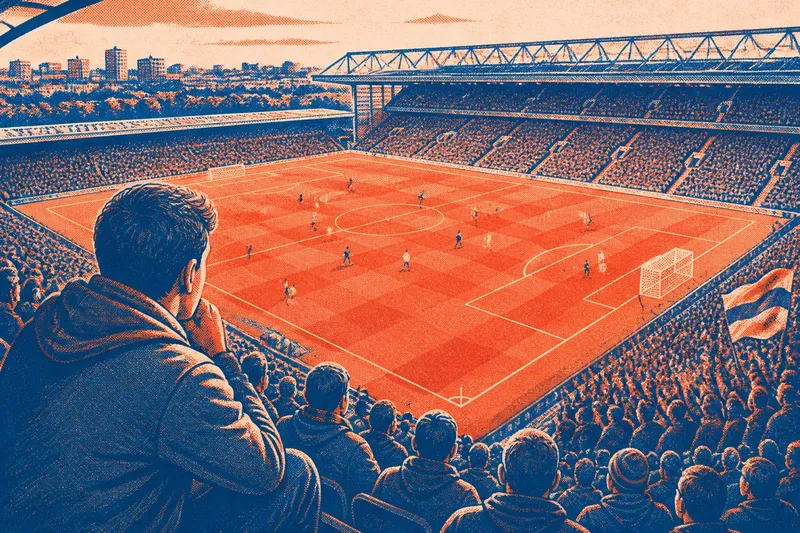
Which stadium seat gives you the perfect view? The honest answer is that the perfect stadium view depends on what you want to notice: the shape of a move, the detail of a contest, or the crowd responding around you. A seat is not a camera position with all the distractions edited out; it is a place inside the event.
Imagine a hypothetical spectator called Rowan, choosing a seat for a football match at a ground they have never visited. Rowan wants to see how attacks develop, but also hopes to follow a player they admire. Those wishes point towards different qualities in a seat, so the choice begins not with a ranking but with a question: what would make the match feel vivid?
Rowan’s first view
Rowan opens the stadium’s seating map and sees blocks arranged around the pitch. The map makes distance easy to compare and may suggest that a central position is automatically best. Yet the map cannot show how the pitch’s lines, nearby spectators, roof supports or the height of the stand shape the view from a particular row.
To clarify the choice, Rowan separates the match into three things they might watch. The first is the team’s overall shape: where players spread out, how space opens, and how one side moves the ball forward. The second is close action: a run, a challenge, a player’s expression. The third is the atmosphere around the ground, including how a section reacts when play turns.
Each has a different visual home. Watching a team’s shape often benefits from a position that gives a broad view across the playing surface. Close action tends to feel more immediate nearer the pitch, though the viewer may lose sight of what is developing elsewhere. A lively section can make the crowd part of the spectacle, but attention will naturally shift between the pitch and those around it.
Angle changes the story
From a seat near the halfway line, Rowan could compare the teams’ positions across the width of the pitch. The view might make changes in formation and passing routes easier to read. But perspective still alters what looks close, what overlaps, and which movement catches the eye first.
A seat behind a goal frames the match differently. Attacks coming towards that end can feel direct and dramatic, while action at the opposite end may appear smaller or less detailed. A seat along the side can make movement across the pitch easier to follow, but a player travelling towards the touchline may seem to disappear into a cluster of bodies.
Height matters alongside angle. From higher up, a spectator may see more of the pitch at once and notice spaces that are hard to read from low down. Nearer the field, bodies and movement become larger, and the pace can feel more immediate. Think of looking at a crowded table: from above, you can see how everything is arranged; from a chair beside it, you notice the grain of the wood and the objects nearest your hand.
Neither viewpoint contains the whole match. The high view can flatten the drama of a close contest, while the low view can make the far side feel distant. The question is not which perspective is universally superior, but which trade-off suits Rowan’s attention.
Distance sets the detail
Distance decides how much of the scene arrives together. Farther back, Rowan may be able to hold more of the pitch in one glance, particularly if the stand rises above the playing surface. The cost is that individual actions can feel less intimate, and small details may be difficult to pick out.
Nearer the pitch, a touch or turn can become much easier to see, but the spectator may need to look from one part of the field to another. The near edge can dominate the view, and an attack at the far end may be harder to follow. A low front row and a raised row further back can therefore produce very different experiences even when they are close together on a map.
Rowan’s admiration for one player seems to favour a seat near the area where that player spends much of the match. But that preference has a catch: players move, and a role does not keep someone in one place. A seat selected for one anticipated patch of action can feel poorly matched when the match shifts to the other end.
What does Rowan want to notice?
Is the halfway line always best?
A central position often gives a balanced view of movement towards either end and can help a spectator compare the teams’ shape. It is not automatically best for following one end, a particular player, or the crowd’s response in a more vocal section.
Do higher seats show more?
A higher seat can reveal more of the pitch at once, which may help someone follow patterns and space. A lower seat can make nearby action feel larger and more immediate, though it may narrow the scene.
Does being closer mean seeing better?
Closer usually means that nearby movement occupies more of the view, not that every part of the match becomes clearer. For an expansive view of play, extra distance and height may be more useful than proximity alone.
Can one seat suit every sport?
No single position serves every event equally, because the playing area, direction of action and spectator’s interest all differ. A seat that works well for following play across a pitch may not offer the same perspective for an event focused on a smaller central area.
A choice made for attention
Say Rowan decides that reading the teams’ shape matters more than seeing one player’s face. They choose a raised seat near the middle of a side stand, after checking the ground’s seating map and any available seat-view images. The expected result is a broader view across the pitch, with some loss of closeness to individual duels.
Had Rowan chosen a lower seat behind a goal instead, the expected experience would have changed: attacks towards that end might feel more direct, while the far end would be harder to read in detail. Neither choice is a correction to the other. Each gives the match a different visual emphasis, and the spectator can judge that emphasis before buying a ticket.
Seat-view images, when available, can help reveal rails, roof edges or parts of the playing area that a simple plan cannot show. They are still a guide to a fixed position, not a promise of an unobstructed view throughout the event. Depending on the ground and event, spectators, flags or the movement of people nearby may enter the sightline.
Rowan also considers the crowd. A seat among supporters who sing and react together may make the atmosphere feel close, even if it is not the strongest position for studying the far side of the pitch. Someone who wants to watch quietly may prefer a section where following play is the main focus. The sound and behaviour around a seat are part of its character, not a defect to be measured against a single ideal.
For a particular ground, seating plans and seat-view information are useful starting points, but the venue’s own descriptions matter where labels or access arrangements affect a choice. The right position can depend on the event and the spectator’s needs; contact the venue for a specific access question rather than guessing from a map.
Keep the trade-off visible
Rowan’s decision is not a hunt for the best seat in the abstract. It is a choice to favour a broad reading of play over the closeness of a lower view and the intimacy of one end. That decision makes the expected experience legible before the match begins, without pretending to control what will happen on the pitch.
The same approach helps any spectator compare seats: name what you hope to watch, then consider how angle, height and distance support it. A perfect stadium view is not a hidden spot that defeats every compromise. It is the view that gives your attention somewhere worthwhile to go.
And once the match starts, look up from the action now and then. The pitch may be the reason you chose the seat, but a sudden wave of sound or a whole stand leaning forward can become the detail you remember most.